Choosing a UI UX design agency is not the same as hiring someone to make a website look polished. A strong partner shapes how people find information, decide whether to trust you, and move from curiosity to action. That affects conversion rates, sales conversations, customer retention, and sometimes even how easily your team can update and grow the site after launch.
The challenge is that many agencies sound similar on the surface. They all talk about clean design, intuitive experiences, responsive layouts, and user-centered thinking. The real difference is in how they define the problem, validate decisions, collaborate with your team, and connect design choices to measurable business outcomes.
If you are comparing agencies for a new website, redesign, app interface, or conversion-focused digital experience, use the criteria below to choose a partner with the right mix of strategy, creativity, technical awareness, and execution discipline.
What a UI UX design agency should actually do
A UI UX design agency helps plan and design digital experiences that are useful, easy to navigate, visually aligned with your brand, and built around user behavior. UI, or user interface, focuses on the visible elements people interact with, including layouts, buttons, typography, colors, forms, navigation, and responsive components. UX, or user experience, focuses on the full journey, including user goals, friction points, content structure, task completion, accessibility, and conversion paths.
The best agencies do not treat UI and UX as separate decorative layers. They connect them. A beautifully designed page that confuses visitors is not good UX. A logical user flow with weak visual hierarchy may still fail because people cannot see what matters. Your agency should be able to explain how interface decisions support user behavior and business goals.
Typical deliverables may include UX research, competitor reviews, information architecture, wireframes, prototypes, visual design systems, usability recommendations, developer handoff files, and post-launch optimization guidance. Not every project needs every deliverable, but the agency should be clear about what is included and why.
Start with business outcomes, not design preferences
Before you evaluate portfolios or request proposals, clarify what success looks like. A UI UX design agency can only recommend the right approach if it understands the business problem behind the project.
For example, a B2B service company may need clearer positioning, stronger lead capture, and trust-building case studies. A SaaS company may need better onboarding, feature discovery, and trial-to-paid conversion. A local business may need faster mobile navigation, stronger calls to action, and simpler contact flows. The design process should adapt to the outcome.
Use this table to translate business goals into UX evaluation criteria:
| Business goal | UX questions to answer | What the agency should examine |
|---|---|---|
| Generate more leads | Can visitors understand the offer and take action quickly? | Conversion paths, CTAs, forms, trust signals, page hierarchy |
| Improve sales quality | Are the right users being educated before they inquire? | Messaging, qualification content, case studies, service pages |
| Reduce bounce rates | Are users finding what they expected from search or ads? | Landing page relevance, navigation, page speed, mobile usability |
| Support a redesign | What is broken in the current experience? | Analytics, heatmaps if available, user feedback, content gaps |
| Launch a new product | Can users understand value without a long explanation? | Positioning, onboarding flow, product visuals, interaction clarity |
This step also helps you avoid choosing based only on visual taste. Good aesthetics matter, but your website or product interface exists to help users complete tasks and help your business grow.
Look for strategy and research, not just attractive mockups
A strong agency begins by asking questions. Who are your users? What do they need to accomplish? What objections prevent them from converting? Which pages or flows are underperforming? What data do you already have? What constraints exist around technology, budget, timeline, brand, and content?
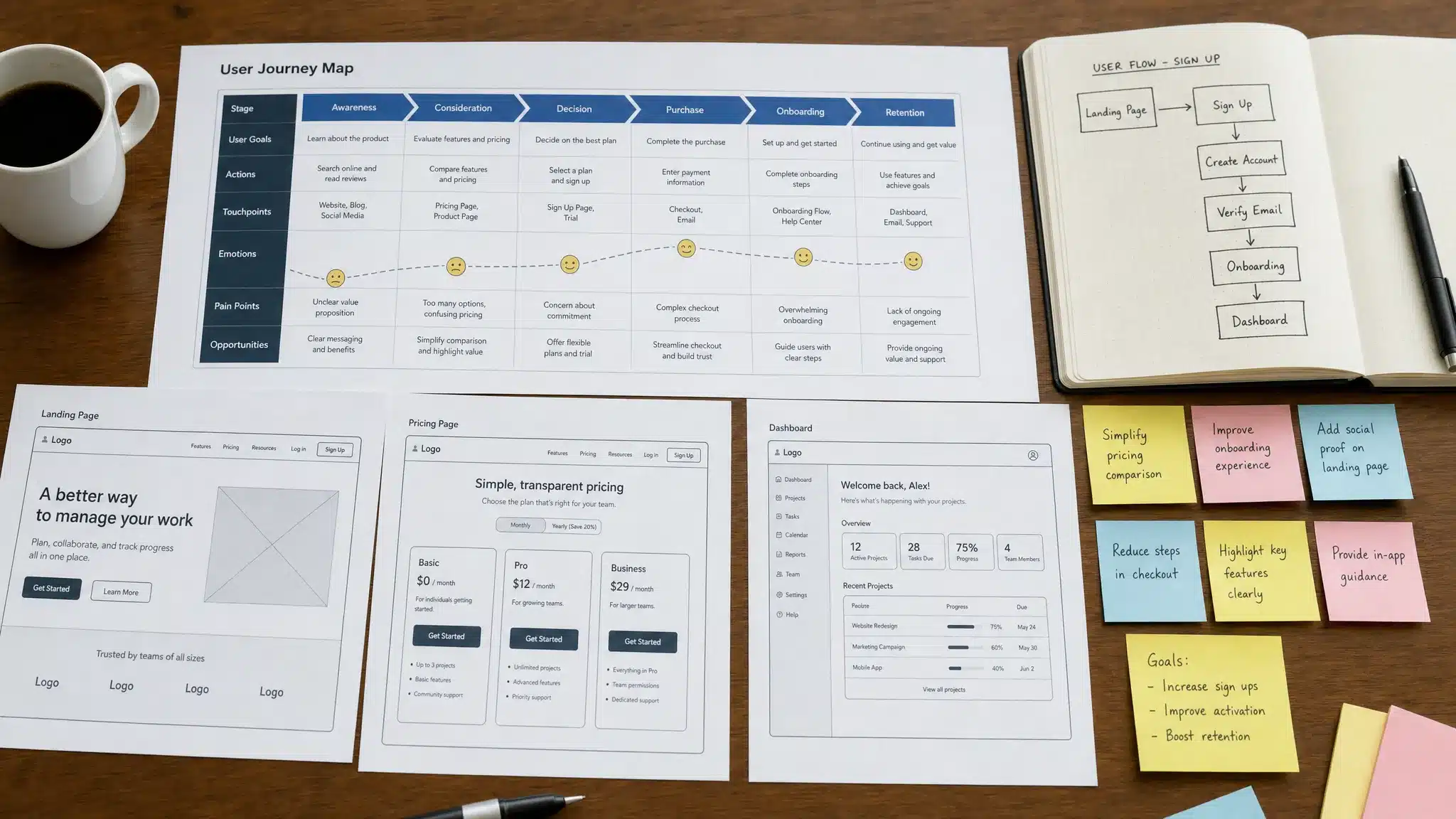
User research does not always need to be expensive or complex. Depending on the project, it might include stakeholder interviews, analytics review, customer surveys, usability testing, competitor analysis, content audits, or journey mapping. What matters is that design decisions are grounded in evidence rather than assumptions.
Established UX principles can also guide evaluation. For example, Nielsen Norman Group’s usability heuristics are widely used to assess clarity, consistency, error prevention, user control, and feedback. Your agency does not need to quote theory in every meeting, but it should demonstrate that its process is based on proven usability thinking.
A useful question to ask is: what will you need to learn before designing? If the agency jumps straight into visual concepts without discussing users, content, conversion goals, and technical constraints, that is a warning sign.
Review portfolios for outcomes, not just visuals
Portfolios are important, but they can be misleading if you only judge screenshots. A polished homepage does not show whether users converted, whether the site loaded quickly, whether the client could manage content easily, or whether the final product worked well on mobile.
When reviewing a portfolio, look for context. Strong case studies explain the client problem, the audience, the design challenge, the process, and the outcome. Even if an agency cannot share sensitive performance data, it should be able to explain its decisions and the reasoning behind them.
Industry experience can be helpful, but it should not be your only filter. An agency that has solved similar UX problems in another industry may be more valuable than one that has simply designed websites that look like your competitors. Look for pattern recognition: complex navigation, long sales cycles, trust-heavy service pages, ecommerce filtering, SaaS onboarding, booking flows, or multi-location content structures.
If you are planning a full website project rather than a standalone interface design engagement, it can also help to compare this process with the broader criteria for choosing a web design agency, since development, SEO, content, and launch support may become just as important as the design phase.
Make sure the agency understands conversion, SEO, and performance
UX is not only about making users feel comfortable. It also affects whether visitors can find your site, understand your value, and take the next step. For business websites, the right agency should understand how design decisions influence search visibility, page speed, mobile usability, and conversions.
For example, a visually impressive page may still underperform if it relies on oversized images, unclear headings, weak internal linking, inaccessible components, or slow-loading animations. Google measures user experience signals through systems such as Core Web Vitals, and Google’s Core Web Vitals guidance highlights loading performance, interactivity, and visual stability as important experience factors.
This does not mean your UI UX agency must replace your SEO team. It does mean the agency should design with technical SEO and performance in mind. Page structure, heading hierarchy, mobile layout, content readability, navigation, and calls to action all shape how users and search engines experience a site. For a deeper explanation, WebHiveZ has covered how UI/UX design can affect Google rankings through performance, mobile-friendliness, structure, and engagement.
Conversion should be part of the conversation as well. An agency designing a lead-generation website should understand how users move from awareness to trust to inquiry. That includes clear value propositions, persuasive service pages, proof points, low-friction forms, and CTAs that match user intent. If lead generation is your main goal, it is worth reviewing the principles behind designing a website that generates leads before you finalize your agency brief.
Use a simple scoring framework
Once you have shortlisted agencies, compare them against the same criteria. This keeps the decision objective and reduces the risk of choosing the most persuasive sales call rather than the strongest partner.
| Evaluation area | What strong looks like | Risk if missing |
|---|---|---|
| Discovery and research | The agency studies users, goals, analytics, competitors, and constraints | Design is based on assumptions |
| UX structure | Clear information architecture, user flows, wireframes, and content hierarchy | Users get lost or fail to act |
| UI quality | Brand-aligned visuals, strong hierarchy, consistent components, responsive layouts | The experience feels inconsistent or generic |
| Conversion thinking | CTAs, forms, trust signals, and page goals are planned intentionally | Traffic does not turn into leads or sales |
| Accessibility | The team considers contrast, keyboard use, readable text, and inclusive patterns | Some users struggle or cannot use the experience |
| SEO and performance awareness | Design supports speed, crawlability, mobile UX, and clean structure | The site looks good but performs poorly |
| Development handoff | Developers receive organized files, states, specs, and component guidance | Designs are implemented inconsistently |
| Measurement mindset | The agency defines what to track after launch | You cannot prove whether the redesign worked |
You can score each category from 1 to 5, then discuss the gaps internally. A lower-cost agency may still be the right fit for a focused project, but you should know exactly what tradeoffs you are accepting.
Evaluate the design process before you evaluate the price
Price matters, but process tells you what you are actually buying. Two agencies may quote very different fees because they are not offering the same level of research, strategy, testing, design depth, project management, or handoff support.
A typical UI UX design process might include discovery, UX strategy, sitemap or flow planning, wireframes, visual concepts, responsive design, prototype review, revisions, developer handoff, quality assurance, and launch support. Some projects also include usability testing, design systems, content strategy, or post-launch conversion optimization.
Ask the agency to walk you through a real project from kickoff to launch. Pay attention to how decisions are made. Who approves wireframes? How many revision rounds are included? What happens if user research contradicts stakeholder preferences? How are mobile layouts handled? How does the agency collaborate with developers? How are accessibility and performance reviewed?
A mature process does not have to be slow or bureaucratic. In fact, a clear process usually saves time because it reduces rework. The risk comes from vague promises, such as unlimited creativity, quick redesigns without discovery, or final visuals before the UX structure has been validated.
Check accessibility and inclusive design standards
Accessibility is a core part of UX, not a final checklist item. Your website should be usable by people with different abilities, devices, environments, and levels of technical confidence. That includes readable typography, sufficient color contrast, keyboard-friendly interactions, descriptive labels, predictable navigation, and clear error messages.
The W3C Web Content Accessibility Guidelines are the leading reference for digital accessibility. Your agency does not need to turn every sales conversation into a compliance lecture, but it should be familiar with accessibility fundamentals and willing to design with them in mind.
Inclusive design also improves the experience for everyone. Clear labels help rushed mobile users. Strong contrast helps people in bright sunlight. Simple forms reduce abandonment. Predictable navigation helps first-time visitors. If an agency treats accessibility as optional, it may also overlook basic usability details that affect your broader audience.
Understand communication, ownership, and handoff
A great design can still fail if collaboration breaks down. Before signing, clarify how communication will work. You should know who your main point of contact is, how often meetings happen, where feedback is documented, and how decisions are approved.
Ownership is another important detail. Confirm who owns the final design files, design system, prototypes, icons, and other assets after payment. If the agency uses stock assets, fonts, third-party libraries, or templates, ask what licenses apply and whether there are ongoing costs.
Handoff matters if another team will build the design. Developers need more than a static mockup. They need component states, responsive behavior, interaction notes, spacing logic, form validation guidance, and clarity around edge cases. If the same agency handles design and development, ask how its designers and developers collaborate before launch.
For WordPress, Webflow, and other CMS-driven websites, also ask how the design will translate into editable content. A layout that looks impressive but is difficult for your marketing team to update can create long-term friction.
Compare pricing based on scope and value
UI UX design agency pricing can vary widely because projects vary widely. A small landing page design, a full website redesign, a SaaS dashboard, and a multi-step ecommerce experience are not comparable projects.
Instead of asking only for a total price, ask what is included. The proposal should clarify deliverables, timeline, meeting cadence, research depth, number of pages or templates, revision rounds, prototype expectations, testing, handoff, and post-launch support. If something is excluded, it should be stated clearly.
Be cautious with unusually low quotes. They may be reasonable for a narrow project, but they may also indicate missing strategy, generic templates, limited revisions, weak documentation, or no performance consideration. On the other hand, the highest quote is not automatically the best. The right choice is the agency that can show a clear connection between scope, process, expertise, and your expected return.
A helpful question is: what would you remove from the scope if we needed to reduce budget without hurting the core outcome? Strong agencies can explain tradeoffs clearly.
Pro-Tip for Integration:
Aap in points ko apne article ke beech mein jahan suit karein, wahan include kar sakte hain. Example ke taur par:
“What a UI UX agency should actually do” wale section ke foran baad “The Psychology of UI/UX” add karein.
“Review portfolios” wale section ke sath “Design Systems vs. Template-Based Design” ka hissa lagayein.
“Questions to ask” wale section se pehle “Handling Feedback” aur “Post-Launch Maintenance” ko fit karein.
Watch for red flags
Some warning signs appear early in the sales process. If you notice several of these, keep looking.
- The agency talks mostly about visual style and rarely asks about users, goals, content, or data.
- Every portfolio piece looks similar, regardless of industry or audience.
- The team promises major conversion gains without understanding your traffic, offer, or sales process.
- Mobile experience is treated as a smaller version of desktop rather than a primary design context.
- Accessibility, page speed, and SEO structure are ignored or dismissed.
- The proposal is vague about deliverables, revisions, ownership, or handoff.
- The agency cannot explain how feedback will be managed or how decisions will be prioritized.
- You feel pressured to approve a design direction before discovery is complete.
The right agency should make you feel more confident, not more confused. You should leave early conversations with sharper goals, clearer priorities, and a better understanding of what the project requires.
Questions to ask before you sign
Use these questions in your discovery calls or proposal review meetings. You do not need perfect answers to every question, but you should expect thoughtful responses.
- How do you define success for a UI UX project like ours?
- What research or discovery do you recommend before design begins?
- How will you use analytics, customer feedback, or stakeholder insights?
- Can you show a case study where UX decisions improved business outcomes?
- How do you approach mobile-first and responsive design?
- How do you consider accessibility during the design process?
- What role do SEO, page speed, and conversion strategy play in your work?
- What deliverables will we receive at each stage?
- How are revisions, feedback, and approvals handled?
- What support is available after launch or handoff?
The best answers will be specific. A good agency can describe its process in plain English, explain why each step matters, and adapt its recommendations to your business context.
If you are evaluating partners for a conversion-focused website, WordPress build, Webflow project, or redesign, WebHiveZ can help you assess your current experience and identify opportunities for better design, performance, and SEO. Start with a free audit and use what you learn to make a smarter agency decision.