A high-performing website is never just a beautiful set of pages, and it is never just a collection of optimized keywords. The best results happen when web design and SEO are planned together from the first strategy conversation.
When they work separately, design can create a polished website that search engines struggle to understand. SEO can bring visitors to pages that fail to earn trust or convert. When they work together, your site becomes easier to find, easier to use, and easier to turn into leads.
For business owners, marketers, and teams planning a new website or redesign, this alignment matters more than ever. Search is more competitive, users are less patient, and Google continues to reward pages that provide helpful content and strong user experiences.
Web design shapes how users experience your SEO
SEO brings people to your website, but design determines what happens next.
A page can rank well and still underperform if users land on it and feel confused. They may not know what you offer, where to click, or why they should trust you. Search engines can detect many of these poor experience signals indirectly through engagement patterns, technical performance, and page quality.
Good design supports SEO by helping visitors immediately answer three questions:
- Am I in the right place?
- Can this business solve my problem?
- What should I do next?
This is where layout, navigation, visual hierarchy, copy placement, forms, buttons, and trust signals all become SEO assets. They keep people engaged and make your organic traffic more valuable.
If you want a deeper foundation on how search engines evaluate and rank websites, WebHiveZ has a helpful plain-English guide on what SEO is and how it works.
SEO gives web design a strategic purpose
Design without SEO can look impressive but miss the real business opportunity. SEO gives design a roadmap based on user intent, search demand, content structure, and technical requirements.
Before choosing layouts, colors, or animations, an SEO-informed design process asks questions like:
Who is searching for this service? What problems are they trying to solve? What information do they need before they contact us? Which pages should exist, and how should they connect? What keywords and topics belong on each page?
These answers influence the website architecture, homepage sections, service page templates, blog structure, internal links, and conversion paths. In other words, SEO helps design become more than decoration. It turns design into a system for visibility and growth.
According to Google Search Central’s SEO Starter Guide, making a site useful, understandable, and easy to navigate is central to helping both users and search engines. Those are design decisions as much as SEO decisions.
Where web design and SEO overlap
The relationship between design and SEO is not limited to adding keywords after a website is finished. The overlap appears in nearly every important website decision.
| Website decision | Design impact | SEO impact | Business impact |
|---|---|---|---|
| Site architecture | Helps users find the right page quickly | Helps search engines crawl and understand priority pages | More qualified visitors reach conversion pages |
| Mobile layout | Improves readability and interaction on phones | Supports mobile-first indexing and usability | Fewer lost leads from poor mobile experience |
| Page speed | Reduces friction and frustration | Supports Core Web Vitals and crawl efficiency | Better engagement and conversion potential |
| Heading structure | Makes content easier to scan | Clarifies page topics and hierarchy | Visitors understand offers faster |
| Internal links | Guides users to related content | Distributes authority and improves discoverability | More visitors move deeper into the site |
| Calls to action | Makes the next step obvious | Supports intent match and engagement | More organic traffic becomes leads |
This is why web design and SEO should not be treated as separate tasks on a project checklist. They are connected systems.
Mobile-first design is now SEO-first design
Most users experience your website on a phone before they ever see it on desktop. That means your mobile layout is often the real version of your website.
Mobile-first design affects SEO because it influences readability, navigation, speed, tap targets, content visibility, and conversion flow. If users have to pinch, zoom, wait, or search for basic information, the page is not doing its job.
A mobile-first approach does not mean shrinking a desktop design. It means prioritizing the most important content and actions for smaller screens first, then expanding the experience for desktop. For SEO, this helps ensure that key content, headings, links, and calls to action remain accessible across devices.
WebHiveZ covers this topic in more detail in its guide to mobile-first website design and SEO, which is especially useful if your analytics show high mobile traffic but weak conversions.
Page speed connects user patience, rankings, and revenue
A slow website creates a bad first impression before users even see your design. It can also limit the impact of your SEO work by increasing friction on landing pages.
Speed is not just a developer concern. Design choices directly affect performance. Large images, heavy animations, unnecessary scripts, bloated page builders, too many fonts, and unoptimized video embeds can all slow down a website.
Google’s Core Web Vitals documentation on web.dev focuses on real-world user experience metrics like loading performance, responsiveness, and visual stability. These metrics are not the only SEO factors, but they are important indicators of whether a page feels smooth and usable.
The best approach is not to remove all visual interest. It is to design with performance in mind from the start. That means compressing images, using clean code, limiting unnecessary effects, selecting lightweight components, and testing templates before launch.
Content structure should be designed before content is written
Many websites fail because content is forced into a design that was created without considering search intent. The result is often thin service pages, generic headings, awkward sections, or important information hidden behind tabs and sliders.
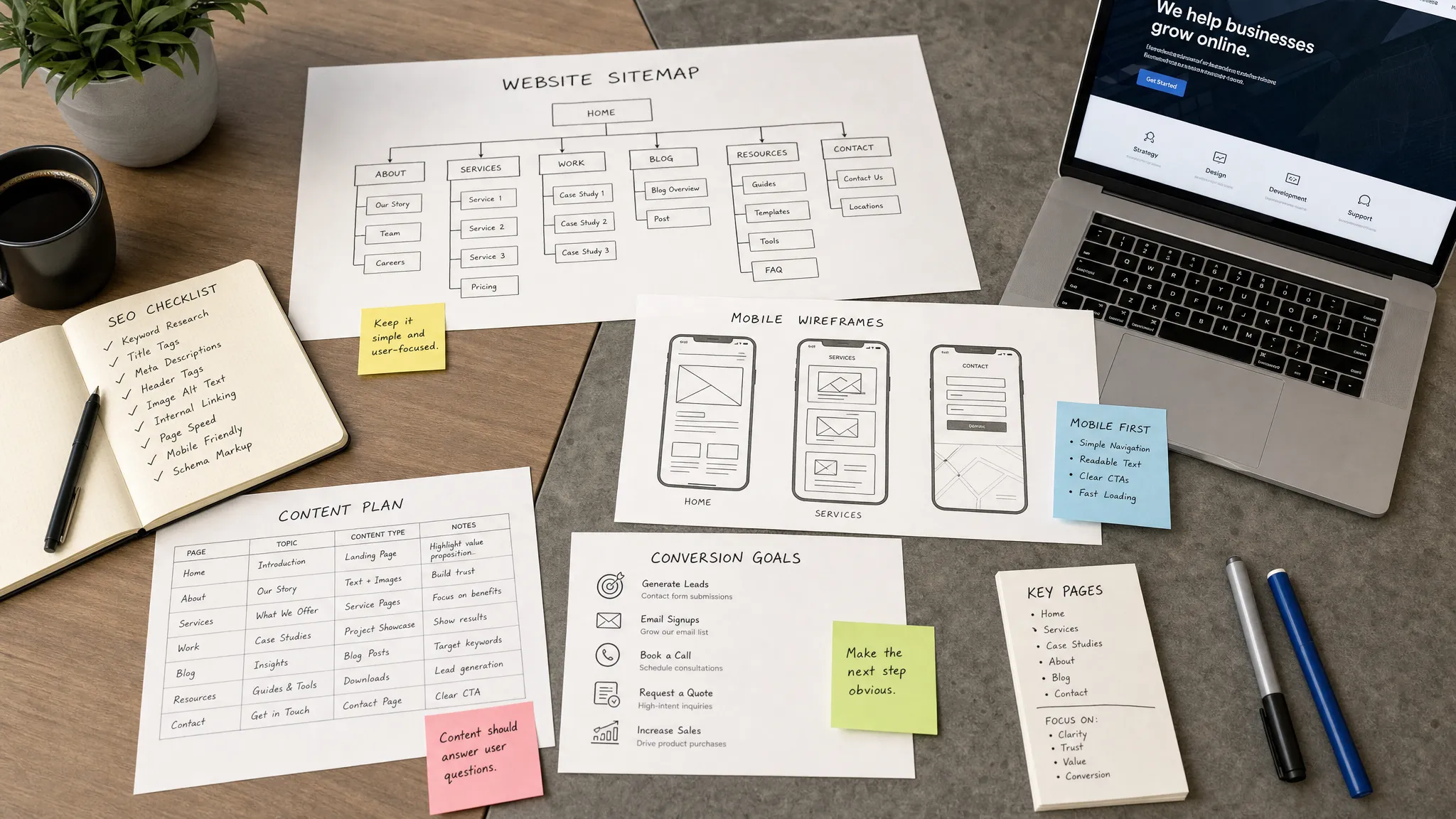
An SEO-friendly design process starts with content structure. Each key page should have a clear purpose, a primary search intent, supporting sections, relevant FAQs, and a conversion path.
For example, a service page should typically explain what the service is, who it is for, the problems it solves, what the process looks like, proof of credibility, and how to take the next step. The exact layout may vary, but the page should answer the visitor’s questions in a logical order.
Design then makes that information easier to consume. It uses spacing, typography, icons, cards, accordions, comparison sections, testimonials, and calls to action to reduce cognitive load. The goal is not to make the page longer for SEO. The goal is to make it complete, useful, and easy to navigate.
Internal linking is both UX and SEO
Internal links are often discussed as an SEO tactic, but they are also a design and user experience tool. They help visitors move from broad information to specific solutions.
For example, a blog article can link to a related service page, a service page can link to a case study, and a homepage section can guide users toward the most relevant offer. This helps search engines understand relationships between pages, but it also helps people continue their journey without hitting a dead end.
The best internal links feel natural. They are placed where a user would genuinely benefit from more context or a next step. If your site has many pages but weak connections between them, WebHiveZ has a detailed guide on building an internal linking strategy for SEO.
Conversion-focused design makes SEO more profitable
Ranking higher is valuable, but rankings alone do not pay the bills. The real goal is to turn qualified organic visitors into inquiries, bookings, purchases, or subscribers.
Conversion-focused design aligns each page with the user’s intent. Someone reading an educational blog post may need a softer call to action, such as a guide, audit, or related article. Someone viewing a service page may be ready for a consultation or quote.
Strong conversion design usually includes:
- A clear headline that matches the visitor’s problem or goal
- Trust signals such as reviews, results, certifications, or client logos
- Simple forms that ask only for necessary information
- Calls to action placed at natural decision points
- Visual hierarchy that makes the most important action easy to find
This is where SEO and design become especially powerful together. SEO attracts the right audience. Design guides that audience toward action.
Technical SEO should influence design and development choices
Some SEO issues are invisible to users but still affect performance. A website can look excellent while hiding crawlability, indexing, or rendering problems.
Technical SEO should be considered during design and development, not added as a final check. Important considerations include clean URL structure, proper heading hierarchy, schema opportunities, XML sitemaps, indexable content, canonical tags, image alt text, redirects, and accessibility basics.
JavaScript-heavy designs need special attention because important content may not always be easy for search engines to access. Image-based text can look stylish but may reduce accessibility and search clarity. Infinite scroll can create discovery problems if it is not implemented carefully.
A technically sound website gives your content the best chance to perform. It also reduces the risk of needing expensive fixes after launch.
How to align web design and SEO in a website project
The most efficient way to combine web design and SEO is to build collaboration into the process from day one. That means strategy, design, development, and content should not operate in isolation.
A practical workflow looks like this:
- Discovery and goals: Define the business objective, target audience, key offers, competitors, and conversion goals.
- SEO research: Identify search intent, priority topics, keyword themes, content gaps, and page opportunities.
- Site architecture: Map pages, navigation, URL structure, and internal linking paths before visual design begins.
- Wireframes and content planning: Build page structures around user questions, SEO requirements, and conversion points.
- Design and development: Create responsive, fast, accessible templates that support content and search visibility.
- Pre-launch SEO review: Check metadata, headings, redirects, indexing settings, schema, speed, analytics, and tracking.
- Post-launch optimization: Monitor rankings, traffic, engagement, conversions, and technical health.
This process prevents the common mistake of designing a full website, then asking an SEO specialist to “optimize it” at the end. By then, the biggest SEO decisions have already been made.
Common mistakes when design and SEO are separated
When teams work in silos, websites often suffer from predictable problems. The site may look modern but load slowly. The navigation may be creative but confusing. Pages may have beautiful visuals but not enough useful content. Blog posts may attract traffic but provide no path to conversion.
Other common issues include missing H1 tags, duplicate page templates, weak service page copy, oversized media files, broken redirects after redesigns, poor mobile spacing, and calls to action that are hard to find.
These mistakes are avoidable when web design and SEO are treated as one growth strategy. A designer should understand how users search and navigate. An SEO strategist should understand how layout, branding, and user experience affect behavior.
What businesses should look for in a web design and SEO partner
If you are hiring an agency or planning a redesign, look for a team that can connect strategy with execution. A strong partner should be able to discuss visual design, WordPress development, technical SEO, content structure, performance, and conversion goals in the same conversation.
Ask how they handle SEO before design begins. Ask whether they plan site architecture and redirects. Ask how they test mobile experience and page speed. Ask how they measure success after launch.
WebHiveZ helps businesses build high-performing websites with services that include custom website development, WordPress development, Webflow website design, UI/UX design, technical SEO, page speed optimization, AI-assisted website design, and launch support. That kind of end-to-end approach is valuable because the decisions that affect growth are connected across the entire website lifecycle.
Build a website that looks good and performs
The strongest websites are not built by choosing between design and SEO. They are built by combining both into one strategy.
If your website needs to attract more qualified traffic, load faster, communicate more clearly, and convert more visitors into leads, WebHiveZ can help you plan and build with growth in mind. Explore WebHiveZ’s website design and SEO services at webhivez.com and start with a site that is designed to perform from day one.