eCommerce UX trends 2027 point to one clear priority. Make your store easy for people and AI agents to use. The top pick is agentic commerce readiness. That means clean product data and structured markup plus a fast checkout. It suits Shopify and WooCommerce owners who want more sales from AI search and mobile shoppers. Global online sales are heading toward $8 trillion by 2027 according to Statista. Yet about 70% of carts are still abandoned. Poor UX is a big part of that loss. This guide compares the main trends and shows the effort each one needs. You will also see where to start so your eCommerce website design earns more conversions.
What Are the Biggest eCommerce Trends for 2027?
Six shifts matter most for online shopping trends in 2027. Some need design work. Others need better data. Use this table to compare them.
| Trend | What changes | Effort | Best for |
|---|---|---|---|
| Agentic commerce | AI agents compare and buy for shoppers | Medium | Large catalogs |
| GEO and AEO | Products appear in AI answers | Low to medium | Any store |
| AI personalization | Pages adapt to shopper intent | Medium | Repeat buyers |
| Mobile checkout | Wallets and guest checkout | Low | Mobile heavy traffic |
| Social and omnichannel | Selling in feeds and in store | Medium to high | Brands with physical presence |
| Compliance | EAA and digital product passports | Medium | EU facing sellers |
Start with the low effort rows. Mobile checkout and GEO give quick wins. Agentic commerce and personalization take more planning but carry the biggest upside.
Agentic Commerce: When AI Agents Shop for Customers
Agentic commerce means an AI agent searches for products and compares options. Then it completes the purchase for the shopper. The shopper sets the goal. The agent does the legwork.
Big platforms are building the rails. OpenAI and Stripe created the Agentic Commerce Protocol behind ChatGPT Instant Checkout. Google introduced the Universal Commerce Protocol. Microsoft launched Copilot Checkout. Your store needs to work with these systems.
Shoppers are still careful. A Commercetools survey found 65% trust AI to compare prices. Only 14% let AI place the order. DHL reports that 29% of shoppers are open to AI purchases. Deloitte says 68% of retailers expect agentic AI adoption.
What this means for your UX:
- Keep price and stock accurate in your product feed.
- Use a PIM so titles and attributes stay consistent.
- Write return and shipping rules in plain language.
- Keep a human checkout path for buyers who want control.

AI Search and Product Discovery: From Keywords to Intent (GEO/AEO)
Shoppers now ask full questions. They type “best running shoes for flat feet under $100” and expect one clear answer. Intent based search replaces simple keyword matching.
GEO (Generative Engine Optimization) and AEO (Answer Engine Optimization) help your products appear in those answers. Adobe reported AI referral traffic to UK retail sites grew by more than 1400%. That is small in volume but it grows fast.
Practical steps:
- Add Schema.org markup for products and reviews and FAQs.
- Write product pages that answer real buyer questions.
- Keep your structured data and product feed in sync.
- Improve your on site search so it understands intent.
Our guide on AI search optimization explains how to prepare your site. Our search engine optimization team can also handle the technical setup.
AI-Powered Personalization and Customer Service
AI personalization is moving past “you may also like” blocks. Generative UI can rearrange a page based on what a shopper is doing. A first time visitor sees trust signals. A returning buyer sees their usual size and a quick reorder button.
An AI shopping assistant can also answer sizing and delivery questions at any hour. Conversational commerce works best for simple tasks. Klarna is a useful warning. The company pushed AI customer service hard and then brought humans back after quality dropped. Over automation hurts trust.
Good rules to follow:
- Let AI handle order status and returns and basic product questions.
- Offer a clear route to a real person.
- Test personalization on one page type first.
- For B2B ecommerce add a self service portal for reorders and invoices.

Mobile-First Design and Frictionless Checkout
Mobile makes up about 62% of ecommerce sales. Mobile first design is no longer optional. Thumb friendly buttons and fast pages and short forms decide who wins.
Checkout is where money leaks. Around 70% of carts are abandoned and Baymard Institute research ties much of that to checkout friction. Estimates put the loss from poor UX near $1.4 trillion.
Checkout fixes that cut cart abandonment
- Guest checkout: Never force account creation.
- One step checkout: Show fewer fields on one screen.
- Digital wallets: They hold about 56% of global ecommerce spend. Offer Apple Pay and Google Pay and PayPal.
- BNPL: Buy now pay later options help on higher priced items.
- Speed: Slow pages kill conversion rate. Read our WordPress speed optimization guide for fixes.
Frictionless checkout simply means a buyer can pay in as few taps as possible.
Social Commerce and Omnichannel Shopping in 2027
Shoppers discover products in feeds and not only in search. Social commerce through TikTok Shop and Instagram lets people buy without leaving the app. Short videos and creator reviews do the selling.
Omnichannel is just as important. Unified commerce connects stock and customer data across web and app and store. Shoppers expect BOPIS and click and collect to work smoothly.
Also consider an AR product preview or virtual try on for furniture and fashion and beauty. These tools reduce returns because buyers see what they are getting.

Trust, Zero-Party Data and Privacy in eCommerce
Third party cookies are fading. Stores need data that shoppers give willingly. That is zero party data. It includes quiz answers and size choices and preference centers. The shopper shares it on purpose.
Use it well:
- Ask only what improves the shopping experience.
- Explain why you ask.
- Let shoppers edit their preferences.
- Follow GDPR and local rules such as India’s DPDP Act.
Trust also comes from basics. Show real reviews and clear delivery times and easy returns. Research from Salesforce and Qualtrics keeps pointing to trust as a driver of repeat purchase.
Accessibility and Regulations: EAA and Digital Product Passports
European Accessibility Act
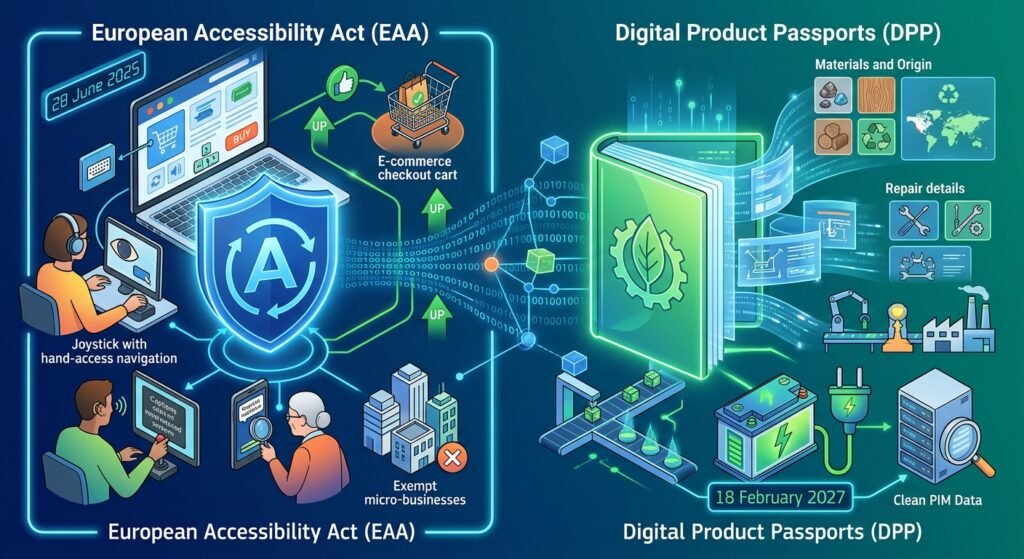
The European Accessibility Act (EAA) has applied since 28 June 2025. Many online stores that sell to EU consumers must meet it. Small micro businesses may be exempt. The usual benchmark is WCAG 2.2 with EN 301 549. Accessible design also helps all shoppers and often improves conversion.
Digital Product Passports
A Digital Product Passport (DPP) is a digital record of a product’s materials and origin and repair details. It comes from the EU ESPR framework. Battery passports under the EU Battery Regulation become mandatory on 18 February 2027. Sellers in affected categories need clean PIM data now.
How to Prepare Your Store for 2027
Follow these steps in order:
- Audit your UX: Check mobile speed and checkout steps and accessibility.
- Fix your data: Clean your product feed and PIM and schema markup.
- Simplify checkout: Add guest checkout and wallets.
- Add AI carefully: Start with search and support and keep a human option.
- Collect zero party data: Build one quiz or preference form.
- Plan for rules: Review EAA and DPP needs for your markets.
- Measure: Track conversion rate and cart abandonment monthly.
Good UI UX design makes most of these steps easier. A conversion focused website design gives them a strong base. If you run WooCommerce our WordPress development team can build and scale it for you.
eCommerce UX trends 2027 reward stores that stay fast and clear and easy for both shoppers and AI agents. If you want help turning these ideas into a store that sells more, our team at WebHivez is ready. Contact us today for a free audit and a clear plan.
Frequently Asked Questions
What are the top eCommerce trends for 2027?
The biggest trends are agentic commerce and AI search visibility and personalization. Mobile first checkout and social commerce also matter. New rules like the EAA and digital product passports add compliance work.
What is agentic commerce?
Agentic commerce is when an AI agent shops on behalf of a customer. It finds and compares and can even buy products. Stores need clean product data and open checkout protocols to take part.
What is GEO/AEO and why does it matter?
GEO and AEO are ways to optimize content for AI generated answers. They matter because shoppers increasingly ask AI tools for product advice. Structured data and clear answers help your products get cited.
Will AI agents replace human online shoppers?
No. Most shoppers trust AI to compare options but few let it place orders. Humans will still choose and approve purchases. AI will mostly handle research and routine reorders.
What is a digital product passport?
A digital product passport is a digital record of a product’s materials and origin and repair information. It is part of the EU ESPR rules. Battery passports are required from 18 February 2027.
How do I prepare my online store for 2027?
Start with a UX audit and fix your product data. Then simplify checkout and make your site accessible. Add AI tools step by step and track conversion rate as you go.